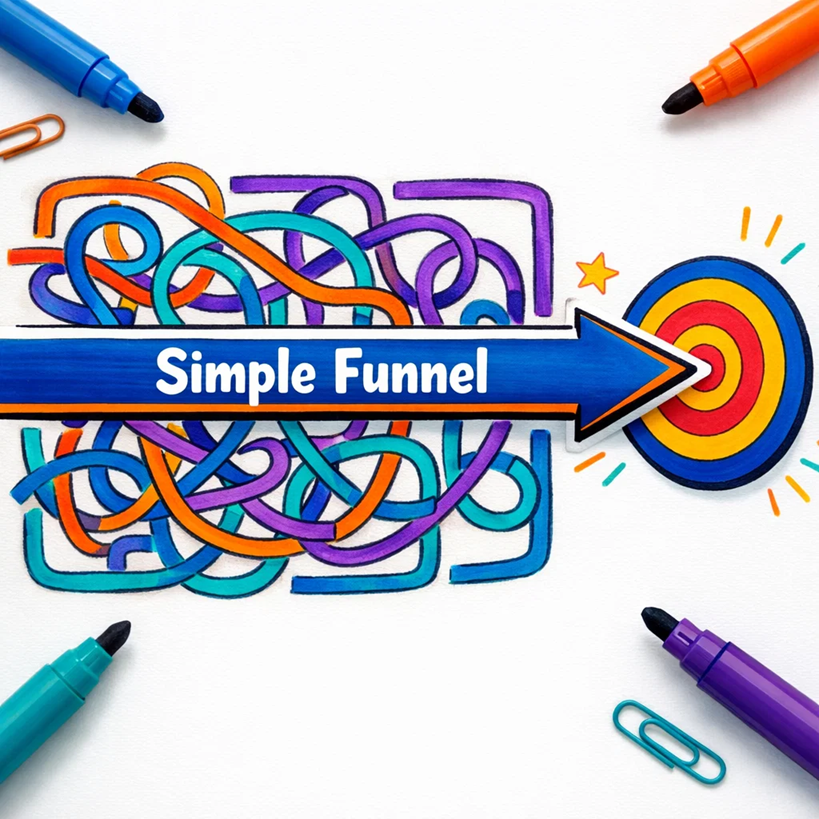
Affiliate marketing has a way of making things look more complicated than they need to be.
Spend a little time online and you will see diagrams with ten different pages, automated email sequences, upsells, downsells, retargeting ads, webinars, and tools stacked on top of tools.
For someone just starting out, it can feel overwhelming.
The assumption becomes simple. If successful marketers use complex funnels, then complexity must be the secret.
But in reality, complexity is one of the biggest reasons affiliate funnels fail.
Most funnels do not fail because the idea is bad. They fail because too many moving parts create confusion, friction, and distraction.
The truth is that the most effective funnels are often surprisingly simple.
Let’s explore why funnels break down and how keeping things simple can make your affiliate marketing much more effective.
The Hidden Problem With Complex Funnels
When people design their first affiliate funnel, they often try to include every tactic they have ever heard about.
Landing page.
Lead magnet.
Email sequence.
Bridge page.
Upsell page.
Bonus page.
Scarcity timer.
Multiple offers.
On paper it looks impressive.
In practice it creates a fragile system where any weak link can cause the entire funnel to collapse.
If the landing page is confusing, people leave.
If the email sequence feels pushy, people unsubscribe.
If the offer does not match the promise of the first page, trust disappears.
Every additional step introduces another opportunity for something to go wrong.
That is why many beginners spend weeks building funnels that barely convert.
Too Many Decisions Kill Momentum
There is another problem that often goes unnoticed.
Every extra page in a funnel asks the visitor to make another decision.
Should I click this button?
Should I read this page?
Should I sign up for this email list?
Should I watch this video?
The more decisions you introduce, the more likely someone will hesitate.
And hesitation on the internet usually means leaving.
People online are busy and distracted. They prefer clear paths and simple choices.
The more direct the journey, the higher the chance they will follow it.
Simplicity Builds Clarity
The strongest affiliate funnels usually focus on one thing.
Helping someone move from a specific problem to a useful solution.
That journey does not require complicated structures. It requires clarity.
Clear content that explains the problem.
Clear recommendations that explain why the product helps.
Clear calls to action that make the next step obvious.
When readers understand exactly what to do next, friction disappears.
Instead of feeling like they are moving through a marketing system, they feel like they are following helpful guidance.
That difference matters more than most people realize.
The Simple Funnel That Works
A surprisingly effective affiliate funnel often looks like this.
Helpful content.
A clear recommendation.
A link to the product.
That is it.
The content could be a blog post, a video, or a social media thread. Its purpose is to educate, explain, or solve a problem.
Inside that content, you introduce a product that helps address the issue.
Then you provide a clear way for the reader to learn more.
There is no maze of pages. No unnecessary complexity.
Just useful information and a logical next step.
This approach works because it mirrors the way people naturally make decisions online.
They search for answers.
They read or watch something helpful.
They try a recommended solution.
Simple funnels align with that natural behavior.
When Email Fits Into the Picture
Email can be a powerful part of affiliate marketing, but it works best when it supports the funnel rather than complicates it.
Instead of forcing every visitor into an email list before they see the offer, think of email as a relationship tool.
Some readers are ready to explore the recommendation immediately.
Others want to learn more over time.
Email gives those readers a way to stay connected without pressure.
A simple lead magnet or helpful resource can invite them into your list naturally.
From there, you can continue sharing useful insights and occasional recommendations.
The key is that email should enhance trust, not block access to the solution.
The Real Goal of a Funnel
Many people think the purpose of a funnel is to maximize conversions.
While conversions matter, the deeper goal is something else.
Trust.
A good funnel builds confidence in your recommendations.
Each step reassures the visitor that they are in the right place and that the product genuinely helps solve their problem.
When trust is strong, people move through the funnel naturally.
When trust is weak, even the most sophisticated funnel struggles.
That is why simple funnels often outperform complex ones. They keep the focus on helping rather than persuading.
The Trap of Constant Tweaking
Another reason funnels fail is constant tinkering.
New affiliate marketers often change pages, headlines, designs, and tools every few days hoping to find the perfect formula.
But without consistent traffic and data, these changes rarely provide meaningful insights.
Instead of improving the funnel, they create confusion about what is actually working.
A simple funnel allows you to focus on the most important variable.
The quality of your content.
Strong content attracts the right audience, explains problems clearly, and introduces solutions in a natural way.
Once that foundation is strong, the funnel rarely needs complicated adjustments.
Start Small and Improve Gradually
If you are building your first affiliate funnel, resist the temptation to overengineer it.
Start with the basics.
Create helpful content that solves a specific problem.
Recommend a product that genuinely helps.
Provide a clear path for readers to explore that product.
As your audience grows, you can gradually add supporting elements like email sequences or bonus resources.
But those additions should support the core funnel, not replace it.
Simple systems are easier to manage, easier to understand, and easier for your audience to follow.
The Funnel That Lasts
The affiliate funnels that stand the test of time rarely rely on tricks or complicated systems.
They rely on clarity, usefulness, and trust.
When someone arrives on your content and quickly understands how you can help them, the funnel begins to work almost effortlessly.
That simplicity is not a weakness.
It is the strength that keeps your marketing focused on the people you are trying to help.
And when your audience feels supported instead of pushed, they are far more likely to take the next step.
Get the 7-day Affiliate Jumpstart plan here: