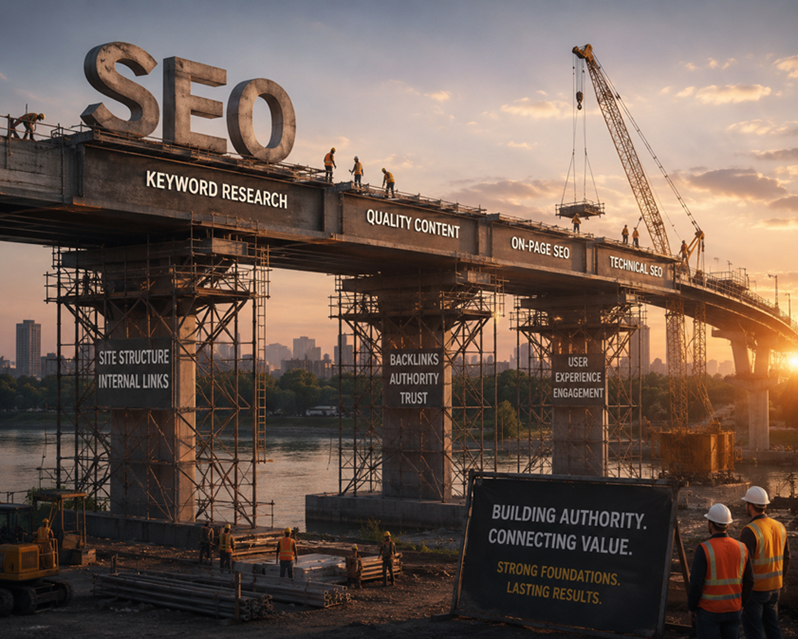
One of the hardest parts about SEO is how quiet it feels in the beginning.
You publish a blog post.
Optimize your headings.
Add keywords.
Improve your site structure.
And then…
Nothing.
No flood of traffic.
No instant rankings.
No dramatic growth overnight.
That delay causes a lot of people to quit too early.
Because SEO rarely feels exciting at first.
It feels uncertain.
Most SEO Results Take Longer Than People Expect
A lot of beginners secretly hope SEO will work in a few weeks.
Usually, it does not.
In most cases, meaningful SEO growth takes:
- several months for early traction
- six to twelve months for stronger momentum
- longer in competitive niches
That does not mean nothing is happening during that time.
It just means search engines move slowly when evaluating newer content and websites.
Google Needs Time to Trust Your Site
This part matters.
When your site is new, Google has limited information about:
- your consistency
- your content quality
- your expertise
- user engagement
- your overall site structure
So rankings often start slowly.
Over time, as you publish more useful content and your site grows, trust increases gradually.
Early SEO Often Feels Invisible
One frustrating reality is that progress usually happens before you can clearly see it.
Your pages may start:
- getting indexed
- appearing on page 8
- moving to page 5
- then page 3
Long before traffic becomes noticeable.
This is why many people assume “SEO is not working” when it actually is.
The movement is just happening quietly.
Content Volume Matters More Than Single Posts
A single article rarely changes everything.
SEO works more like accumulation.
Each useful article strengthens:
- your topical relevance
- your internal linking
- your site authority
- your keyword coverage
This is why websites with dozens or hundreds of useful pages often grow faster over time.
Momentum compounds.
Some Posts Rank Faster Than Others
Not all keywords behave the same way.
A post targeting:
“How to start a blog with no experience”
may rank faster than:
“Best affiliate marketing software”
because competition levels differ dramatically.
Lower competition topics usually gain traction earlier.
Especially for smaller websites.
Consistency Speeds Up Learning
One hidden benefit of consistent publishing is feedback.
The more content you create, the more you learn:
- what gets impressions
- what earns clicks
- what holds attention
- what Google seems to favor
That feedback loop improves future content.
Which slowly improves rankings overall.
SEO Is Usually Uneven
This surprises many beginners.
Traffic growth rarely looks smooth.
Often:
- nothing happens for months
- then one article starts ranking
- then several pages rise together
- then growth accelerates unexpectedly
SEO tends to compound in waves.
That delayed momentum is normal.
Technical SEO Helps, But Content Still Matters Most
People often overcomplicate SEO.
Technical improvements matter:
- site speed
- mobile usability
- internal linking
- structure
But most small sites do not fail because of tiny technical issues.
They fail because:
- content is inconsistent
- topics are too competitive
- articles lack depth
- the site stops publishing too soon
Useful content still drives most long-term SEO growth.
Search Intent Is More Important Than Word Count
Long articles alone do not guarantee rankings.
Google mainly wants content that solves the searcher’s problem clearly.
Sometimes that takes 800 words.
Sometimes 2,500.
The better your content matches intent, the better your chances of ranking over time.
SEO Rewards Patience More Than Intensity
This is important psychologically.
Many beginners sprint for one month, then disappear.
But SEO rewards steady consistency far more than short bursts of motivation.
Publishing:
- one useful article every week
- improving older posts
- learning gradually
often beats aggressive short-term publishing followed by burnout.
Your First Rankings Usually Feel Small
Your early SEO wins may look unimpressive:
- 10 visitors
- 30 visitors
- one keyword ranking
- a few clicks from Google
But those small signals matter.
Because they prove your site is starting to gain visibility.
That early traction often leads to larger growth later.
The Bigger Picture
SEO is slower than social media.
Slower than paid ads.
Slower than viral content.
But it also compounds differently.
A useful article can continue bringing traffic:
- months later
- years later
- even while you sleep
That is why SEO remains so valuable despite the slower timeline.
The hardest part is surviving the quiet stage.
The period where growth is happening underneath the surface before the results become obvious.
Most people quit there.
The ones who stay consistent long enough are usually the ones who eventually see momentum build.
Get the 7-day Affiliate Jumpstart plan here: